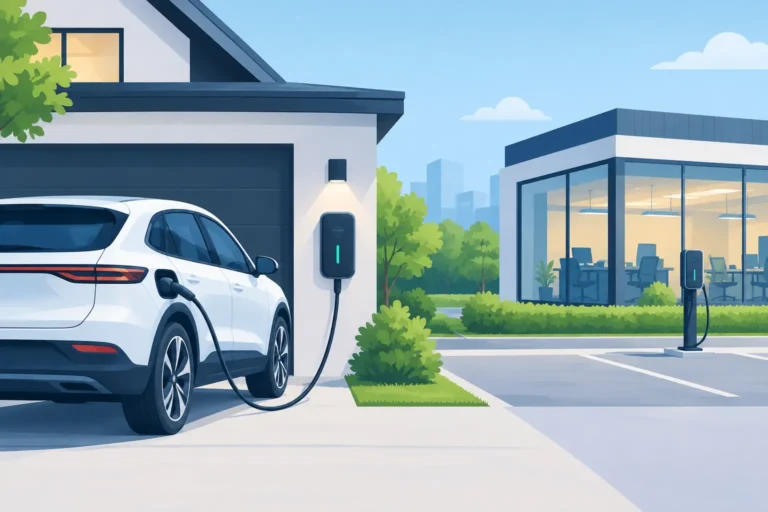
A car park with one charger is a useful employee benefit. A car park designed around the right charging system can become a long-term asset for your business, tenants or visitors. The best commercial EV chargers are not necessarily the highest-powered or most expensive units. They are the chargers that suit how people use your site, work safely with its electrical supply and leave room for growth.
For businesses, landlords and managing agents across London and the Home Counties, the decision usually comes down to more than the charge point itself. Electrical capacity, user access, payment arrangements, cabling routes and future demand all need to be considered before installation begins.
What makes a commercial EV charger the right choice?
Commercial charging has a different job to home charging. It may need to serve staff during an eight-hour shift, visitors who stay for an hour, residents who charge overnight, or a fleet that must return to the road on schedule. Those patterns determine the right charging speed, number of units and management system.
A good commercial installation should be reliable, straightforward for drivers to use and manageable for the site owner. It should also be designed by an experienced electrical contractor that can assess the existing distribution equipment, protective devices, earthing arrangements and available supply capacity.
The most suitable system will normally include smart controls. These allow charge points to communicate with each other and share the power available on site, rather than overloading the incoming supply when several vehicles plug in at once. This is known as load balancing or dynamic load management. It is often the difference between installing a scalable charging network and facing costly supply upgrades too early.
The best commercial EV chargers by use case
There is no single answer to which charger is best. The right specification depends on dwell time, the number of users and the electrical infrastructure already in place.
Workplace charging
For offices, warehouses, schools and similar workplaces, 7 kW and 22 kW AC chargers are commonly the most practical option. Employees are generally parked for several hours, so there is usually enough time to add meaningful range without the cost and demand associated with rapid DC charging.
A 7 kW unit is suitable where the electrical capacity is limited or drivers park for a full working day. A 22 kW unit can be a strong choice for higher-turnover workplaces, provided the site has a suitable three-phase supply and enough capacity. In many cases, a combination of intelligent load management and several well-positioned AC chargers offers better value than a small number of very high-powered units.
Look for controlled access through RFID cards, an app or approved driver lists. This means the business can offer charging as a staff benefit, recover electricity costs where appropriate, or separate employee and visitor use.
Flats, managed developments and rental properties
For residential developments, the priority is often fairness and future provision. Residents need a dependable way to charge overnight, while landlords and managing agents need clear billing and a system that can grow as EV ownership increases.
Individual assigned parking bays may suit dedicated smart chargers linked to each resident’s account. Shared car parks often benefit from networked chargers with user authentication, usage reporting and payment options. The electrical design matters greatly here. Installing containment and cable routes for future bays while other work is taking place can avoid disruption and unnecessary cost later.
Leasehold properties also require careful planning around permissions, common electrical supplies and responsibility for ongoing operation. A site-specific design gives everyone a clearer picture of what is being installed and how it will be managed.
Fleet and service vehicles
Fleets need predictability. A charger that looks impressive on paper is of little use if vehicles are not ready when drivers need them. The first step is to understand the daily mileage, return times, vehicle battery sizes and whether vans are parked overnight or only between jobs.
AC charging is often sufficient for vehicles that return to base overnight. Where vehicles need a quicker turnaround, DC rapid charging may be appropriate. However, DC equipment has higher installation costs and can require significant electrical upgrades. It is best specified where the operational benefit genuinely justifies the investment.
Fleet sites also benefit from scheduling. Smart systems can prioritise selected vehicles, spread charging through cheaper tariff periods or make use of solar generation when it is available. This can protect running costs as the fleet expands.
Public and destination charging
Retail, hospitality and leisure venues may use charging to attract customers and encourage longer visits. Here, easy payment is essential. Drivers should be able to understand availability, start a session and pay without unnecessary friction.
The right power level depends on how long visitors usually stay. A hotel or restaurant may find AC charging appropriate, while a location focused on shorter visits may need faster charging. Reliability, clear bay markings, lighting and accessible positioning are just as important as the hardware itself.
Power, capacity and future expansion
Before choosing equipment, a competent installer should carry out a detailed site survey. This checks the existing supply, switchgear, cable routes, parking layout and likely demand. It also identifies whether any Distribution Network Operator involvement may be needed.
It can be tempting to install the maximum number of chargers immediately. Often, a more sensible approach is to install the infrastructure for future expansion while beginning with the number of active charge points the site can support economically. Ducting, containment, spare capacity in distribution boards and allowance for future communications can all make later phases simpler.
Dynamic load management is particularly valuable where a building already has substantial electrical loads, such as air conditioning, machinery, kitchens or heat pumps. It monitors demand and adjusts vehicle charging within safe limits. Drivers still receive a dependable service, while the business avoids drawing more power than the site can safely provide.
Features worth specifying
When comparing the best commercial EV chargers, focus on the whole operating system rather than the appearance of the unit. The charger should be compatible with recognised open communication standards where possible, so the site is not unnecessarily tied to one software provider. It should provide accurate energy metering, user access controls and clear reporting.
For charge points used by multiple drivers, consider whether you need pay-as-you-go payments, staff tariffs, visitor charging or monthly invoicing. Think about who will deal with driver queries and how faults will be monitored. A lower upfront price can become poor value if support, replacement parts or software arrangements are unclear.
Physical details count too. Tethered cables can be convenient for regular users, while socketed units may be more flexible for mixed vehicle types. Pedestal mounting can work well in open car parks, whereas wall-mounted units can reduce costs close to a building. Protective bollards may be needed where vehicles could strike equipment.
Installation quality is part of the charger decision
An EV charger is a substantial electrical load, not simply an accessory on a wall. Safe installation requires correct circuit design, isolation, earthing assessment, protective devices, testing and certification. The work should integrate properly with the building’s wider electrical system.
For sites with solar PV and battery storage, charging can be planned as part of a broader energy strategy. Smart controls can help make better use of solar electricity, while battery storage may support demand management in the right circumstances. The benefits depend on the site’s generation profile, tariff and vehicle charging pattern, so realistic expectations matter.
Home EESS approaches commercial charging as part of the complete electrical picture. From survey and system design to installation, testing and ongoing support, the aim is an uncompromised installation that remains practical as your needs change.
Choose for the next five years, not just this year
The strongest commercial EV charging projects begin with simple questions: who will charge, when will they charge, how quickly do they need to leave, and what can the building safely supply? Once those answers are clear, the specification becomes far easier to get right.
A well-designed system does more than supply electricity. It gives staff, residents, customers or fleet drivers confidence that charging will be available when it matters, while helping the property prepare for lower running costs and the continued move to electric transport. A site survey is the sensible next step – it turns an ambition for EV charging into a safe, scalable plan.