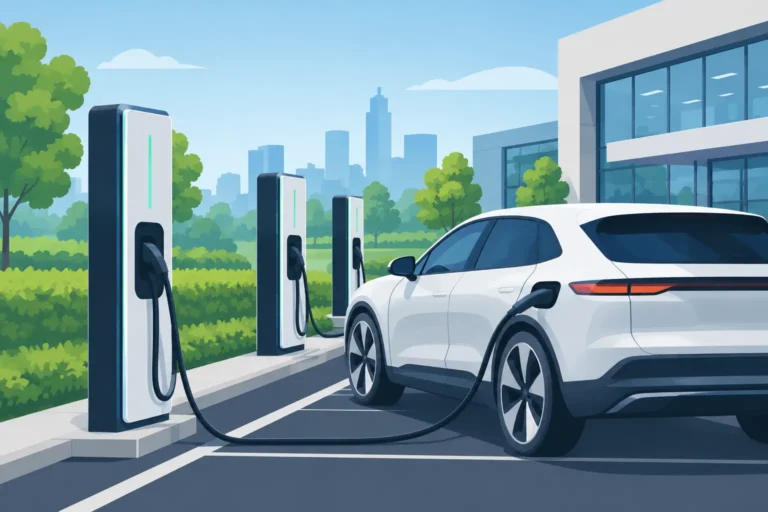
A workplace EV charging installation is no longer just a staff perk. For many businesses, it is a practical improvement to the property: helping employees charge where they park, supporting electric company vehicles and preparing the site for changing travel habits. Done properly, it can also work alongside solar generation and battery storage to give you greater control over energy costs.
The key is to start with the electrical capacity of the building, not the number of charge points you would ideally like to see in the car park. A good system should be safe today, easy to use every day and capable of growing without unnecessary disruption or expensive remedial work later.
Start with the building, not the charger
Every commercial site has a different electrical starting point. A small office with six parking bays has very different requirements from a warehouse with a growing electric van fleet, a school, a block of managed flats or a customer-facing business. The charging equipment may look similar, but the supply capacity, cable routes, parking layout and daily demand can vary considerably.
Before specifying equipment, an experienced electrical contractor should assess the incoming supply, existing distribution boards, maximum demand and the condition of the installation. This determines whether the current supply can safely support EV charging or whether upgrades, additional protection or coordination with the local electricity network operator may be required.
This early assessment protects the rest of the project. Installing chargers without understanding the available capacity can lead to nuisance tripping, constrained charging speeds or costly upgrades after the fact. It is particularly important in older commercial buildings, where the electrical installation may not have been designed for significant new loads.
A site survey should also consider practical details that affect both cost and appearance. These include the distance from the electrical intake to the parking spaces, whether cabling can run through existing routes, the need for groundworks, the position of bollards and how chargers will be protected from vehicle damage. Good workmanship is not only about the charger on the wall. It is about a safe, durable installation from the supply right through to the parking bay.
Design workplace EV charging installation for real use
The right charging speed depends on how long vehicles are parked and who will use the system. Staff cars that remain on site for a full working day can often be served effectively by standard AC workplace chargers. Vehicles that need to return to the road throughout the day may need higher charging capacity, although this places greater demand on the building supply and can increase installation costs.
There is no value in paying for high-power equipment if vehicles will normally sit parked for eight hours. Equally, a slow arrangement may become frustrating for a sales team, service engineers or delivery fleet with short turnaround times. The best specification matches the charging window to the working pattern.
It is also worth deciding who needs access. Your chargers may be for employees only, allocated company vehicles, tenants, visitors or a mixture of users. Access control can help prevent unauthorised use, while user accounts and reporting can make it easier to understand consumption and recover charging costs where appropriate.
For a small team, a straightforward system with clear rules may be all that is needed. For multi-tenant premises or businesses with several vehicles, management features become more valuable. Usage data, driver identification, scheduled charging and payment options can reduce administration as the scheme grows.
Smart load management makes expansion possible
Smart load management is one of the most important parts of a commercial charging design. Rather than allowing every charger to draw full power at the same time, the system monitors the available capacity and shares it intelligently between connected vehicles.
This means a business may be able to install more charge points without immediately upgrading its electricity supply. Charging is automatically reduced when the building demand is high and increased when capacity is available. Staff can still arrive, plug in and leave their vehicles to charge, while the site stays within safe operating limits.
There is a trade-off. If many vehicles are connected on a limited supply, individual charging speeds will reduce at busy times. But for cars parked all day, this is often far more cost-effective than paying for a major supply upgrade. A proper assessment will show whether load management is the sensible route or whether a larger supply is justified by your operational needs.
Make solar, storage and charging work together
For businesses with solar PV, EV charging can provide another useful home for self-generated electricity. Instead of exporting surplus solar power during the day, you may be able to direct more of it into staff vehicles or fleet vehicles parked on site. This can improve the value of your solar generation and make charging costs more predictable.
Battery storage can add further flexibility. It can store solar electricity for later use, support charging at periods of higher demand and reduce pressure on the grid supply. However, battery capacity should be sized around the wider energy profile of the business, not solely around the chargers. A battery may be an excellent fit for a site with regular daytime generation and evening vehicle charging, but it is not automatically the right answer for every property.
The wider electrical picture matters too. If resilience is a priority, it is important to establish which circuits should be supported during an outage. Full house backup is generally discussed for homes, while commercial resilience is usually based around clearly defined essential loads. Chargers are not always the first priority during a power cut, but the same careful design approach can coordinate solar, storage, backup supplies and charging without compromising safety.
Plan for growth without overbuilding
A staged installation is often the most sensible choice. You may only need four active chargers now, yet have space for 12 in the coming years. Installing the right containment, cable routes and distribution capacity at the outset can make future expansion much simpler and less disruptive.
That does not necessarily mean fitting every charger immediately. It means creating a plan that avoids digging up the car park again, reopening finished walls or replacing recently installed equipment. Future-proofing should be proportionate: enough capacity for realistic growth, not an oversized system that ties up capital unnecessarily.
Consider how your organisation may change over the next three to five years. Are more staff switching to electric cars? Is a diesel van fleet likely to be replaced? Will the building be leased to additional occupiers? Could a new solar array be installed later? These questions shape the infrastructure behind the visible charge points.
Do not overlook parking management
Charging spaces need straightforward rules. A charger is most useful when a vehicle can move on after it has received the energy it needs, allowing another driver to use the bay. Clear signage, bay markings and a simple workplace policy can prevent chargers becoming all-day parking spaces for vehicles that are no longer charging.
For employee charging, decide whether electricity is free, subsidised or charged at a set rate. The right approach depends on your company policy, electricity tariff and the level of administration you are prepared to manage. Transparent arrangements tend to work best, particularly as uptake increases.
Choose an installer who can take responsibility
Workplace charging is an electrical infrastructure project, not simply a product purchase. The installer should be able to assess the supply, design the distribution work, select suitable charging equipment, install protection and cabling correctly, test the completed system and explain how it will be operated.
Quality materials and careful installation matter in busy commercial environments. Equipment must withstand regular use, weather exposure where applicable and the risk of accidental damage. The installation should also be properly certificated, with clear records for your building file and future maintenance.
Home EESS brings established electrical contracting experience to solar, battery and EV charging projects across London and the Home Counties. That wider capability is useful when charging is part of a larger upgrade, whether you are improving an ageing consumer unit, adding solar generation, planning battery storage or reviewing the electrical condition of the premises.
Ongoing support deserves attention too. Ask what happens if a charger loses connectivity, a user has an access issue or your business needs to add more charging bays. A dependable installer will not disappear once the equipment is fitted. They will provide clear handover information and remain available as your requirements develop.
A well-planned workplace charging system should feel straightforward for the people using it. Behind that simplicity is careful electrical design, sensible capacity management and an installation built to serve the property for years. Start with an honest site assessment, set out how vehicles will be used, and you can make charging a practical source of convenience, savings and confidence rather than another facilities problem.