An office can have enough electrical capacity on paper yet still face nuisance tripping, costly peak consumption and restrictions on new equipment. Office load management gives businesses control over when and how electricity is used, so essential operations remain protected while energy costs are kept in check.
For offices across London and the Home Counties, this is increasingly relevant. More EV chargers, electric heating and cooling, server equipment, kitchen facilities and battery storage can place real pressure on an existing supply. The right solution is not simply to add more capacity. It is to understand the building’s demand, prioritise the loads that matter and install electrical controls that work safely every day.
What office load management means in practice
Office load management is the planned monitoring, control and prioritisation of electrical demand within a workplace. It helps prevent several high-demand appliances operating at full power at the same moment, particularly where the property’s incoming supply or distribution board has limited headroom.
A typical example is a small office with EV chargers in the car park. If several staff plug in at the end of the working day while air conditioning, catering equipment and IT systems are operating, the total demand can rise quickly. Dynamic load management can reduce the charging rate temporarily, rather than allowing the site to exceed its agreed import capacity or overload a main fuse.
This approach is not about making a workplace less comfortable or limiting normal operations. Properly designed controls protect the loads that cannot be interrupted and manage flexible loads around them. In many cases, occupants will not notice any change at all.
The benefit depends on the building, its tariff and the equipment in use. A modest office with low daytime demand may need only a correctly sized consumer unit and an EV charger with load balancing. A larger office, mixed-use site or premises with a high electrical load may benefit from monitoring, automated controls, solar PV and commercial battery storage working together.
Start with the office load profile
Good decisions begin with real measurements, not assumptions. A site survey should consider the incoming electrical supply, main switchgear, distribution boards, protective devices, cable sizes and the condition of the existing installation. It should also identify the building’s highest-demand periods and the equipment responsible for them.
In an office, demand often behaves differently from the energy bill as a whole. Lighting and computers may create a steady daytime base load, while electric comfort cooling, kettles, microwaves, lifts, printers and EV charging create short but significant spikes. A server room or communications cabinet may need continuous, dependable power, even outside working hours.
Understanding this profile answers practical questions. Can two EV chargers operate at full output without affecting the building? Is there enough spare capacity for a heat pump or new air conditioning? Would a battery be used effectively, or would a supply upgrade be better value? It can also reveal avoidable waste, such as equipment left running overnight or an ageing electrical board that is no longer suitable for the way the office operates.
Set priorities before installing controls
The most useful office load management systems are built around clear priorities. Essential circuits should remain available. Flexible equipment can be reduced, delayed or paused when the building approaches its safe demand limit.
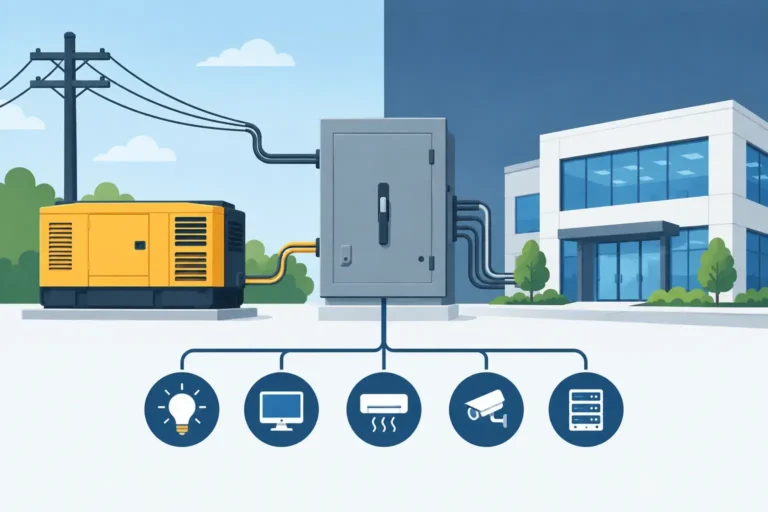
Essential loads commonly include emergency lighting, fire and security systems, IT and communications equipment, critical refrigeration and selected sockets or lighting. The precise arrangement will depend on the premises and the business operating from it. A medical, legal or financial office may have a greater reliance on uninterrupted data and communications than a conventional workspace.
Flexible loads might include EV charging, electric water heating, comfort cooling, battery charging and non-essential kitchen circuits. These do not have to be switched off permanently. They can be managed automatically according to the available capacity, time of day, solar generation or battery state of charge.
This distinction also matters when resilience is a priority. An emergency power supply should be designed around the circuits genuinely needed during an outage. Attempting to run every appliance in the building from a battery can make a backup system expensive and impractical. A well-planned essential-load board provides more dependable backup and makes better use of the stored energy available.
Use solar, batteries and EV charging as one system
Solar PV can reduce the electricity an office imports during daylight hours, often when buildings are occupied and demand is already present. However, solar generation changes with the weather and season. It should be part of the plan, not the sole method of controlling demand.
Battery storage adds another useful layer. It can store surplus solar generation for later use, support the site during predictable high-demand periods and reduce reliance on expensive imported electricity at selected times. For a business with a suitable tariff and load pattern, this can improve the value of both solar and storage.
EV charging is where intelligent controls are particularly valuable. Rather than sizing the electrical infrastructure for every charge point to run at maximum output at once, dynamic load balancing shares the available capacity. Charging continues, but the system responds to what the rest of the office needs. This may avoid a costly upgrade to the incoming supply, although it is not a substitute for one where the existing capacity is clearly insufficient.
The details matter. A battery, solar inverter, EV chargers and building controls must be specified to communicate correctly and installed in line with current electrical requirements. Equipment selection, earthing arrangements, protective devices and circuit design all affect safety and performance. A system that looks attractive on a specification sheet can disappoint if the electrical installation behind it has not been properly assessed.
Protect the supply and the people who use it
Load management should always sit within a sound electrical installation. Before adding new technology, it may be necessary to upgrade a consumer unit, install additional distribution equipment, improve cabling or address observations from an inspection and test report.
For landlords and business owners, this is also an opportunity to plan for future occupation. A flexible office may have changing tenants, more desks, different operating hours or rising demand for workplace EV charging. Allowing sensible capacity and clear circuit labelling now can make later alterations safer and less disruptive.
Where work involves solar generation, storage or backup power, safe isolation is essential. During a grid outage, systems must prevent electricity being exported onto a network that engineers may be working to restore. Backup arrangements also need to switch loads correctly and ensure that the property continues to meet the relevant electrical standards. This is specialist work, not an add-on to be treated casually.
A practical route from survey to support
The strongest projects start with a conversation about how the office actually runs. That includes current electricity use, planned equipment, operating hours, resilience expectations and any known problems such as tripping circuits or slow EV charging.
From there, the electrical installation can be inspected and the available capacity assessed. A proposal should make clear what is being controlled, which circuits are essential, what happens during a power cut and where the limits of the system sit. Clear answers are more valuable than ambitious claims about savings that do not reflect the site’s real demand.
Home EESS combines electrical contracting expertise with solar, battery storage, EV charging and emergency power solutions, allowing these elements to be planned as one accountable installation. Quality workmanship, suitable materials and ongoing support matter because office energy systems are expected to perform for years, not simply pass commissioning on day one.
When a supply upgrade is still the right answer
Load management can make excellent use of the capacity already available, but it cannot create unlimited power. If a business needs substantial new electrical demand at the same time, such as extensive rapid charging, major cooling plant or high-load machinery, an upgrade to the supply or distribution infrastructure may be necessary.
The sensible choice depends on the figures. Controls may defer or reduce the need for an upgrade; they do not remove the need for safe design. A competent assessment will set out the practical options, their constraints and the most suitable route for the building.
A well-managed office electrical system gives you more than lower avoidable consumption. It gives you confidence to add the technology your business needs without gambling on capacity. Start by establishing what your office uses at its busiest, then build a solution that keeps essential work powered and leaves room for the future.